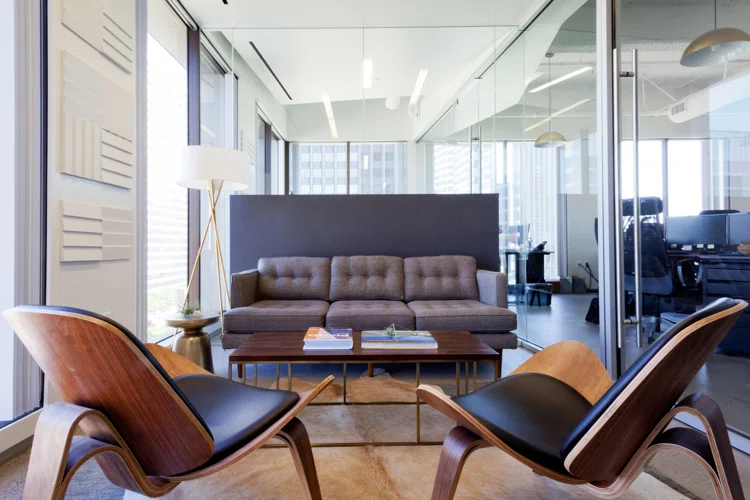

The line between residential warmth and commercial purpose is disappearing. Here's why that matters, and what most businesses are getting wrong.
Think about the last commercial space that made you feel something.
Not impressed. Not overwhelmed. Not even aesthetically pleased. Something. A café where you instinctively settled in rather than perched on the edge of your seat. An office lobby where you didn't feel like a visitor. A store where you lost track of time — not because the merchandise was extraordinary, but because the space itself seemed to understand you.
Now think about how rare that is.
Most commercial interiors are designed from the outside in. Brand guidelines are applied to walls. Furniture is selected from catalogues. Lighting is specified to code. The result is competent, correct, and completely forgettable. You've been in a hundred of these spaces and you can't remember a single one.
The spaces you do remember — the ones you return to, recommend, feel quietly loyal toward — share something in common. They feel considered. They feel like someone understood the humans who would inhabit them.
They feel, for lack of a better word, like home.
Let's be clear about what we don't mean. We don't mean cushions in a corporate lobby. We don't mean a kitchen island in a coworking space. We don't mean the performative domesticity of putting a bookshelf in a hotel room and calling it "curated."
We mean home as a psychological state — the feeling of being welcomed, oriented, and safe enough to stay. Environmental psychologists describe it as the place where our fundamental requirements for safety, comfort, and belonging are met. It's where we let our guard down.
That feeling doesn't require four walls and a mortgage. It requires intent.
The industry calls it "resimercial" — the blurring of residential warmth and commercial purpose. And the numbers suggest it's not a trend. It's a structural change in how people expect to experience commercial environments.
86% of industry respondents agree that corporate environments are evolving toward a residential or hospitality feel. A third of commercial projects since 2017 reflect this shift. And the driving forces aren't going away:
Work has come home. 36% of Australians now work from home regularly. The boundary between domestic and commercial life is permanently blurred. Every space now needs to account for emotional needs previously reserved for the private sphere.
Home is harder to own. Among Australians aged 25–29, home ownership has fallen to 36%. A third have abandoned buying plans entirely. Yet the emotional attachment to "home" has never been stronger. If the dream of home is simultaneously deeply held and increasingly unattainable, the feeling of home must be created elsewhere — in workplaces, venues, and retail environments.
People vote with their feet. Research consistently shows that a 1% increase in dwell time correlates with a 1.3% increase in sales. Spaces with integrated public amenity see 30% higher repeat visitation. Visually complex, warm environments measurably reduce stress hormones. The business case for designing with care isn't soft — it's empirical.
The mistake isn't ignoring this shift. Most businesses sense it intuitively — they know their office feels sterile, their venue feels cold, their retail space isn't generating return visits. The mistake is treating it as a styling problem.
They hire a designer to make the space "feel warmer." They add plants, soften the lighting, swap the hard chairs for upholstered ones. The surfaces change. The experience doesn't.
Because warmth isn't a material palette. It's a design philosophy. It starts with understanding how people actually behave in a space — how they enter, where they pause, what makes them stay or leave, where they feel exposed and where they feel sheltered. It starts the way a good home starts: with the people who will live there.
Charles Eames once described the role of a designer as "that of a very good, thoughtful host, all of whose energy goes into trying to anticipate the needs of his guests."
That idea — designer as host, user as guest — is the key to the resimercial shift. Every commercial space is an act of hospitality. A workplace hosts its team. A café hosts its regulars. A store hosts its customers. And the question for each isn't "what should this look like?" but "how should people feel when they're here?"
When you start there — with feeling, with behaviour, with the psychological conditions for belonging — the design decisions that follow are fundamentally different. You don't choose materials for aesthetics alone; you choose them for how they age, how they feel underhand, how they sound underfoot. You don't plan a floor layout for efficiency alone; you plan it for the rhythm of arrival, gathering, retreat, and departure. You don't specify lighting for ambience alone; you specify it for the way it tells people, unconsciously, that they're welcome here.
This is what we mean by the resimercial shift. Not a trend in furniture. A change in the fundamental question that design starts with.
Here's what's interesting about Brisbane right now. The city has excellent fitout firms. It has excellent brand agencies. But very few practices are genuinely integrating both — starting with what a space should mean before deciding what it should look like.
With Brisbane 2032 on the horizon, the city is about to undergo a wave of commercial development unlike anything in its history. New venues, new workplaces, new hospitality precincts, new public spaces. The question isn't whether they'll be built well — Brisbane has the construction capability. The question is whether they'll be designed well. Whether they'll be places people want to inhabit, or just structures people pass through.
The spaces that get it right will share something in common. They'll feel like someone cared. They'll feel considered. They'll feel — in the best sense of the word — like home.
That's what we're here for.
Butterwood is a design and strategy studio in Brisbane creating commercial spaces where people actually want to be. If you're thinking about a hospitality, workplace, or brand environment project, we'd love to talk about your space.
Whether you're in the early stages of a project, rethinking an existing space, or just curious about what's possible, we'd love to hear what you're working on.
Start a conversation


